Interpreting observed timing and cost
Execution evidence has a wall-clock result and accumulated activity times. Use makespan for elapsed workflow time; use the accumulated values to see where work and waiting occurred. Activities and transfers can overlap, so their totals can exceed makespan.
Use this page when reading a run detail, a planning-versus-execution comparison, or an experiment chart. It explains the current persisted metrics; it does not replace network modeling or the execution state reference.
A flow is a scheduled movement of data
A network flow can occur when a producer and consumer have both an ordering and a data dependency and a plan assigns them to different resources. The run can record the route, bytes moved, duration, and cost when the runtime reports them.
Link bandwidth is in bits per second while dependency size is in bytes. A multi-hop route adds latency for its hops and is limited by its effective available bandwidth. Network modeling works through a concrete transfer estimate.
Contention means simultaneous users of a bottleneck
Two flows contend when they overlap at a shared link or endpoint. PRISM models that sharing when predicting transfers. A real runtime may not report a separate contention value, so use the run's transfer records to see how many bytes moved and how long they took. Network modeling explains the routes behind those predictions.
Four activity-stage timings
Each task attempt has timing fields that describe stages around execution.
| Metric | Current meaning | When it is populated |
|---|---|---|
| Runtime | finishedAt − executionStartedAt; executionStartedAt is container start when reported, otherwise handle start | A completed runtime handle |
| Queue | handle.startedAt − submittedAt | Only when the adapter supplies submittedAt metadata |
| Overhead | containerStartedAt − handle.startedAt | Only when the adapter supplies container-start metadata |
| Transfer | Sum of transfer-run durations prepared for that task | When its preparation gate reports transfers |
InterferenceSeconds is also a persisted task and run-breakdown field. The
current supervisor does not derive it from a runtime handle, so zero means "no
observed value was recorded" rather than proof that CPU interference was absent.
That is different from PRISM's predicted CPU-interference slowdown.
Accumulated stage time is not makespan
For a completed workflow run, AkôFlow calculates observed makespan as:
last completed task finish − first completed task start
The run summary separately sums per-task runtime, queue, interference, and overhead, and separately sums observed transfer durations and transferred bytes. Those sums are accumulated stage time. Parallel work is counted once for each activity that experienced it.
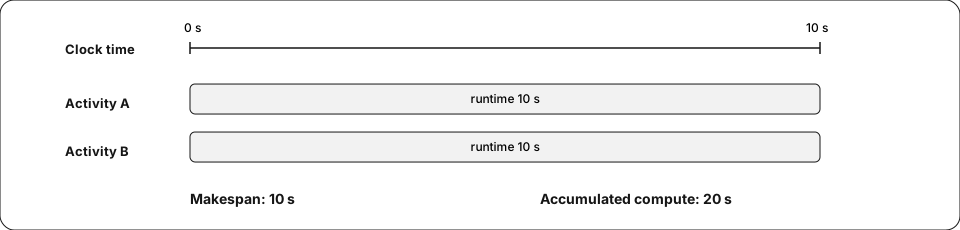
The same applies to concurrent transfers and queue waits. Use makespan to answer "how long did the workflow take?" Use accumulated values to answer "where did the activity work and waiting occur across the whole run?"
Cost is an observed accounting model, not a bill
For completed execution traces, task cost is task runtime multiplied by the
assigned resource's pricePerSecond. The trace also includes observed transfer
cost. For an allocated cloud instance, AkôFlow adds the idle portion
of the resource active window plus persistent-disk price when the resource
metadata has diskPricePerGiBMonth.
This is an internal cost model. A provider invoice can differ because it may use different billing periods, minimum charges, taxes, discounts, network rules, or unmodeled services. Compare a plan's predicted cost with the run's observed modeled cost only when they use the same resource price and scope.
Reading a plan-versus-observed gap
- Confirm the plan and run use the intended workflow version, execution scope, and mode.
- Compare assigned and allocated resources; a different allocation changes the interpretation of the prediction.
- Check individual task queue, overhead, runtime, and transfer fields before using an aggregate chart.
- Inspect transfer source, target, bytes, strategy, and route. A shared copy or existing verified data can explain a lower-than-predicted network cost.
- Treat a zero optional stage field as unavailable unless the selected runtime is known to report that field.