Execution control plane
The AkôFlow server stores requests and dispatches longer work through a durable queue. Planning and execution handlers process those jobs; runtime adapters carry out provider-specific operations.
This is an orchestration explanation, not an API contract. Use the planning and execution state reference for states and endpoints.
From request to durable work
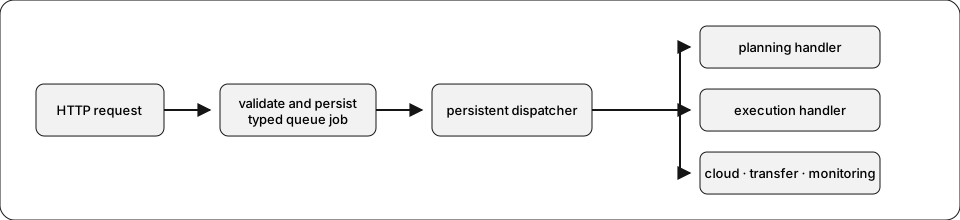
The API can acknowledge a request before its job starts. In particular, an execution request is accepted into the durable queue; the workflow execution run is created when the daemon begins processing that job. In read-only instance mode the server serves inspection APIs but does not run mutating background work.
Planning and execution are separate handlers
A planning handler freezes the inputs for a session, invokes registered algorithms, and persists candidates. A user or API client selects one candidate to create the schedule plan used by execution. The planning explanation covers the significance of that boundary.
An execution handler validates the selected plan and its bindings, then hands the work to the supervisor. The supervisor follows the workflow DAG: it starts an activity only when its control predecessors have completed and its preparation gate has committed. If incomplete activities remain and nothing can run, the run fails rather than silently assuming a valid schedule.
Runtime-independent supervision
Every adapter has the same lifecycle boundary:
type RuntimeAdapter interface {
    Modes() []ExecutionMode
    Start(context.Context, ActivityExecutionContext) (ActivityHandle, error)
    Inspect(context.Context, ActivityHandle) (ActivityHandle, error)
    Stop(context.Context, ActivityHandle) error
}
An ActivityHandle carries the provider job ID and the observations needed to follow it, including status, logs, and any failure. The supervisor inspects these handles while a run is active. It does not currently reconstruct an interrupted workflow run from saved handles after a server restart. The runtime adapters explanation describes each driver behind this interface.
Preparation happens before execution
The supervisor resolves executable variants, workspaces, upstream data, and transfer routes before calling a provider. A preparation gate is committed only after required materializations and transfers are verified. A task therefore cannot be considered ready merely because its predecessor process ended: the required input must also be available at the assigned destination.
For real runs, cloud lifecycle actions can be prewarmed before an activity is dispatched. For a simulation run, the frozen request is given to the simulator; real adapters are not started.
Recovery and failure evidence
Queue jobs retain their owner, attempts, retry timing, and final status. The server also saves runtime handles, transfers, and materializations as evidence.
A failed activity ends its workflow run; the supervisor does not retry the activity. The activity controller can stop a runtime handle internally, but the API has no workflow-run cancellation endpoint. For a completed task, the server also checks its configured output observation. Exit code zero alone is not enough when that observation fails.
The result is an inspectable distinction between what the plan predicted and what the runtime observed. See evidence and provenance for that comparison.